
Los Angeles Resident Lookup Records
To look up a resident in Los Angeles, start with the record that answers the question. Assessment data tie a parcel to an AIN and legal description, but the public Assessor Portal has no owner-name search. The voter tool checks only the user's registration. Court, vital, business, license, and unclaimed-property records add dated clues. Treat each result as evidence from a named custodian, not a complete roll.
| Record | What It Confirms | Where | Access |
|---|---|---|---|
| Assessment | Situs, AIN, legal description, values | LA Assessor Portal | Free web; owner offline |
| Voter registration | Own status and address match | LA voter verification | Free self-check; files restricted |
| Superior Court | Party role, type, dates, location | LASC party index | Paid name; summaries and terminals |
| Vital records | Birth, death, marriage, divorce links | CDPH records plus LA RR/CC | Informational or authorized; restricted |
| Business and licenses | Dated entities, credentials, status | SOS bizfile and DCA | Basic searches free; varies |
| Unclaimed property | Past name, address, holder clues | California Controller | Free; proof to claim |
Use an AIN for an address, LASC for a case, county or CDPH for a family event, and SOS or DCA for a dated affiliation, never residence proof.
Verify a Los Angeles Resident
A reliable resident lookup uses two independent records, not two pages copied from one source. Pair a dated parcel clue with a court, vital, business, license, or historical clue.
- Anchor the person. Start with an address, AIN, event date, case number, or business name. The Assessor Portal has no owner-name search.
- Run the court path. Search name variants and dates in LASC. Save case number, place, role, and type.
- Add an independent event. Compare with a vital copy, dated SOS or DCA record, or the person's voter self-check. That check cannot verify another address.
- Resolve conflicts. Stop when names, dates, or roles conflict. The creating agency handles corrections.
- Docket
- Court record of filings, hearings, and dispositions.
- Index versus image
- An index has selected fields; an image is a document scan.
- Certified copy
- Formal custodian copy, unlike an informational copy.
Los Angeles Resident Court Search
Los Angeles Superior Court's civil index is a paid party-name route for unlimited civil, family law, and probate cases from 1983, limited civil from 1991, and small claims from 1992. Criminal defendant search is separate. Updated daily, it returns party, role, type, filing date, location, and image-count fields. Older matters require Archives.
| Search field or control | Type | Required | Options and format |
|---|---|---|---|
| Search service | Link or tile | Yes | Case by Name; Case by Defendant Name; Case Number; Document Images |
| Last Name / Business Name | Text | Party | Spelling variants |
| First Name | Text | Person search | Narrows same-name results |
| Middle Name / initial | Text | No | Discriminator |
| Date range | Date criteria | Service-dependent | Online coverage limit |
| Case number | Segmented text | Yes for summary | Courthouse choice |
| Filing courthouse | Dropdown | Optional | Limited cases |
| Buttons | Button | Not applicable | Search; Access Case; guest; images |
Guest search costs $4.75 whether it finds a match. Results remain two hours; images 30 days. Courthouse terminals provide free electronic-file viewing. Archives, 222 N. Hill St., handles older files; mail work often takes 8 to 10 weeks.
Use the case-number summary after a name result. A sample result inventory looks like this:
| Result field | What it shows |
|---|---|
| Placement | Case number, courthouse, filing date, type or status |
| Identity | Caption and party roles |
| Activity | Register, hearings, dispositions |
| Documents and limits | Image count; protected material may be withheld |
Summary not official. The case-number follow-up is the LASC case summary; federal matters use PACER.
The official LASC party-name portal shows this resident lookup route.
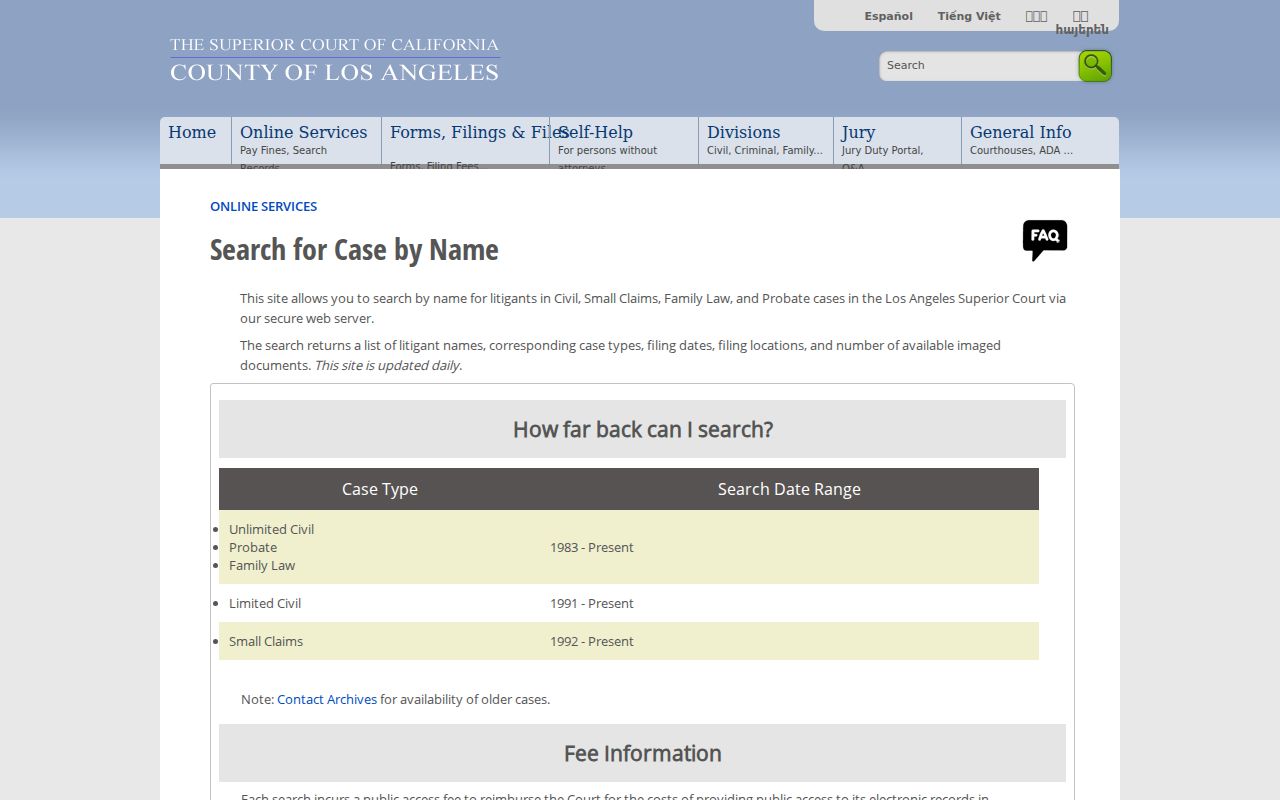
Its name, case-number, and image paths distinguish an index hit from a complete file.
Los Angeles Lookup Myth: Owner Is Resident
Los Angeles property data do not turn an owner into a confirmed occupant. The Assessor Portal offers Basic, Legal, and Map Search for an address, AIN, or legal description. It shows situs, values, improvements, year-built data, parcel status, and legal detail. Owner and mailing-address data are withheld online and may require an assessor office or helpdesk route.
Read an owner or mailing address as a parcel connection, a bizfile agent as an entity role, a permit applicant as project participation, a license address as a credential clue, and a court party as case participation. None alone proves residence.
Capture the AIN, then use the offline owner channel or the Recorder's name-and-year index at Norwalk. If the aim shifts to everyone along a street, the Los Angeles by-street directory follows that angle.
Los Angeles Vital Records and VS Forms
California vital records distinguish authorized from informational copies rather than opening every event after a set number of years. Informational copies are generally available but cannot establish identity. Authorized copies require an eligible relationship or legal basis and a notarized sworn statement under Health and Safety Code sections 103525 and 103526, unless the requester appears before a county employee.
For a Los Angeles event, RR/CC is the local route; the local registrar handles current or recent births and deaths. CDPH is statewide. Its VS application page links VS 111 birth, VS 112 death, and VS 113A public-marriage forms. The 2026 fee schedule lists $31 birth, $26 death, $19 public marriage, and $18 divorce certificates. Fields cover copy type, names, event, relationship, contact, purpose, signature, and parent names when requested.
CDPH mailed authorized requests need the signed form, notarized statement, and check or money order payable to CDPH. Do not send cash. County service uses photo ID and an appointment; VitalChek adds handling and can take up to 20 business days. Birth holdings begin in 1866.
Confidential marriages remain restricted under Family Code section 509. A divorce certificate is an index-style record, not the Superior Court decree. Adoption and original birth files stay confidential. No statewide people index replaces these routes.
Los Angeles Resident Voter Check
The Los Angeles County voter verification form is a self-check, not a street browse. Required fields: Last Name in alphabetic characters, Birthdate mm/dd/yyyy, House Number numeric, and Zip Code five digits. Assistance is 800-815-2666, option 2.
A match confirms the user's own status and address, not another person's. Full voter files are controlled by Elections Code sections 2188 and 2194 and Government Code section 7924.000. Eligible users must state a permitted election, political, scholarly, journalistic, or governmental purpose. Home address, telephone, email, precinct, prior registration, identifiers, and signature have added limits.
County files go by mail or in person to Election Information, room 2013, 12400 Imperial Highway, Norwalk. Countywide is $146; a precinct, district, or city file is $54; additional files are $39. A statewide file costs $100, while a specific-voter request covers up to ten voters at $30 each, subject to the cap. LAPL's historical collection covers 1900 to 1968. History shows election method, never ballot choice.
Heirs, Birth Parents, Classmates
Different questions need different lawful routes. An heir may appear in a probate petition, distribution record, later deed, obituary, or funeral notice. A probate case is a dated lead, not proof of present contact. Pair it with a later source and note the role.
A birth-parent search is not open. California Department of Social Services, court, and CDPH rules control adoption information and intermediaries. Original birth certificates and adoption files stay restricted absent entitlement or court order. For a classmate, LAPL yearbooks, directories, newspapers, and a voluntary alumni channel fit better. Historical address work belongs with the Los Angeles city directories.
Context matters: a probate name can be an heir, creditor, attorney, or witness, and a yearbook name can be a student from one year.
Custody and registry records are separate searches. The LASD Inmate Information Center covers county custody, the CDCR incarcerated-person locator covers state custody, and the California Megan's Law site carries registry warnings. A booking, prison entry, or registration is not proof of guilt or current residence, and status can change.
Los Angeles Resident Business Clues
Business and professional records add a dated affiliation to a Los Angeles resident lookup, not residence proof. SOS bizfile accepts a name or file number; advanced filters add entity type, status, initial filing date, and public-company disclosure. Results can show entity number, jurisdiction, formation date, addresses, agent, and filing PDFs. The default display returns the closest 500 results.
The California Department of Consumer Affairs search accepts board or bureau, license type or number, business, first name, last name, and registry number. Advanced options add city, county, status, and public discipline. Some boards use separate systems. The Medical Board omits some complaints, investigations, and pending or dismissed matters.
Official California license portal shows those public fields.
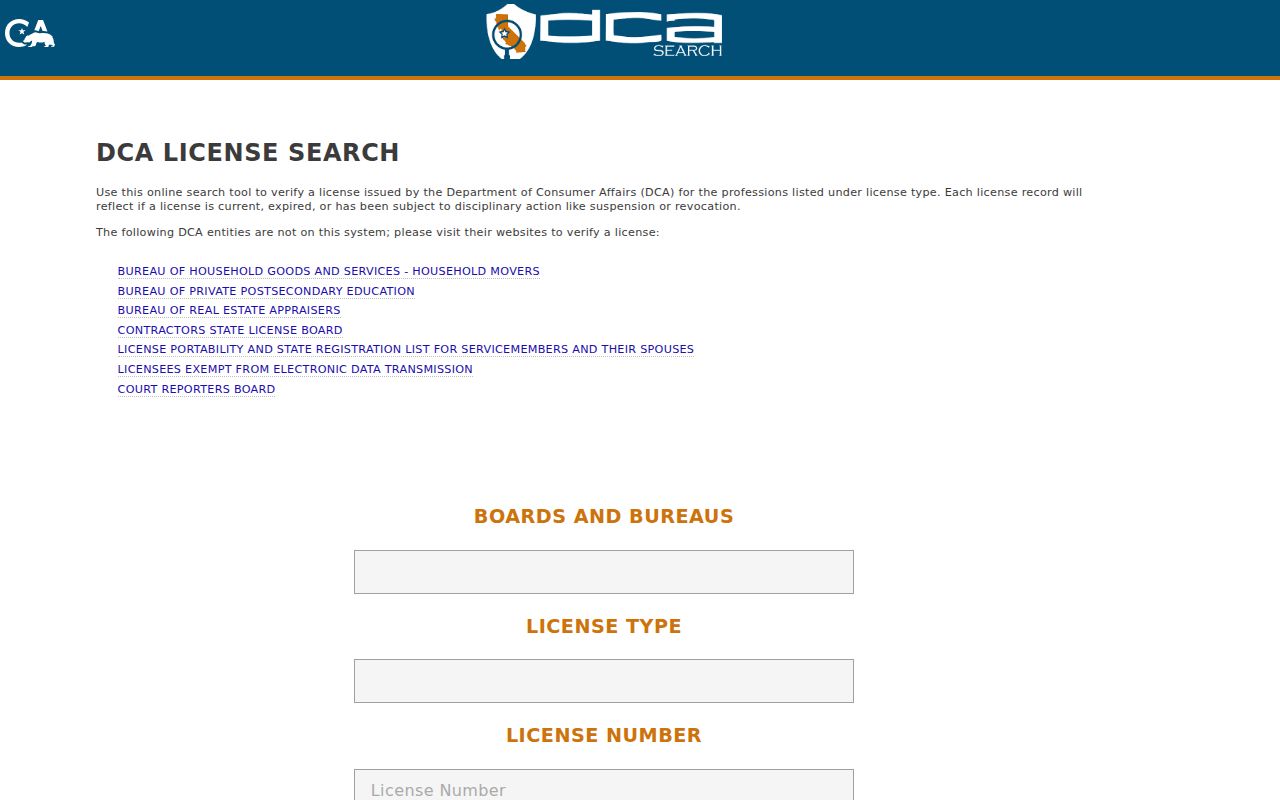
Status, dates, and public discipline can separate similar names, but the record remains professional.
The California Secretary of State business search shows the entity path.
Recent Statements of Information may be free PDFs; certified copies and some partnership records require separate orders. Pair an agent address with dates and an independent record.
Unclaimed Property Is Only a Lead
The California State Controller's unclaimed-property search can test an older name or address clue. A match may show a past name, address, or holder. It does not show a resident and may reflect a stale account or changed name.
Search and claim are free, but proof of entitlement is required. Record the name variation and reported address, then corroborate through a dated court, vital, business, license, or probate record. A claim proves a property report, not that two same-name people are one Los Angeles resident.
Los Angeles Resident Record Requests
When a portal stops, send a targeted request to its custodian. The City of Los Angeles records portal asks for department, description, dates, address or case details, attachments, and contact information, then tracks the request. City departments do not hold County deeds, voter files, vital certificates, or Superior Court files.
For county material, the RR/CC public-records route uses the relevant department and NextRequest. The California Public Records Act, Government Code sections 7920.000 through 7931.000, gives an agency 10 days to decide whether an identifiable record is disclosable, with up to 14 extra days for specified unusual circumstances. It does not require answers or a new list.
Court files follow court rules, and vital, voter, adoption, and Safe at Home records retain their limits. State the record type, dates, name variants, AIN, case number, or license number.
Opt-Outs and Protected Los Angeles Records
Privacy rights can change what a private data broker displays, but do not erase a deed, court filing, voter record, or other government source. The CCPA permits know, delete, correct, and opt-out requests. The DELETE Act's DROP platform sends one encrypted request to registered brokers. Processing began August 1, 2026.
Safe at Home protects eligible victims of domestic violence, stalking, sexual assault, child abduction, elder or dependent-adult abuse, trafficking, and specified threatened health-care or public-entity affiliates. Government Code sections 6205 through 6211 govern it; section 6208.1 limits display of a participant's home address, phone, or image after demand. A suppressed result may signal protection. Never republish a substitute address.
Correction belongs with the source. A private business handles a CCPA request; the Assessor, court, recorder, voter office, or license board handles its amendment process. A downstream result cannot repair the official file. Voter addresses, telephone numbers, email, precinct data, identifiers, and signatures remain confidential outside controlled channels.
Los Angeles Resident Lookup Limits
A Los Angeles resident lookup can end at a lawful boundary. Sealed or juvenile court material, adoption files, confidential marriages, DMV data, Safe at Home records, and non-listed household information do not open because another source has a similar name. Voter-file misuse can be a misdemeanor under Elections Code section 18109. Label matches by role and date.
Lawful personal use. Use a Los Angeles resident lookup for personal research, family history, estate questions, reconnecting, or civic curiosity. Do not stalk, harass, intimidate, threaten, or harm anyone. Public availability does not cancel access rules.