
Los Angeles Previous Residents: Era Sources
Los Angeles previous residents leave different records because title, occupancy, construction, and household events have different custodians. A deed chain reaches 1851; an accessible directory sequence starts in 1873 and digitized selections run later. The same address may surface in maps, voter registrations, census, permits, newspapers, and court files. Match each era to its source, and keep the name, address form, legal description, date, and citation together.
| Source | Years It Covers | Where Held | What It Shows |
|---|---|---|---|
| Los Angeles County Registrar-Recorder/County Clerk (RR/CC) title records | 1851-present | Norwalk recorder offices | Grantor, grantee, legal description, and recording details |
| Los Angeles city directories | 1873-1942 core; 1875-1987 digital selection | Los Angeles Public Library (LAPL) and Tessa | Names, addresses, occupations, and reverse listings |
| REDI and LUPAMS aids | 1982-1991; 1991-Dec. 2005 and Jun. 2006-Mar. 2014 | LAPL house-history resources | Recorded-document and property-index clues |
| California voter registrations | 1900-1968 | Ancestry Library Edition at LAPL | Historical voter names and addresses |
| Federal census | Through 1950 | LAPL, National Archives at Riverside, and databases | Household members, relationships, ages, and occupations |
| Sanborn fire maps | 1888-1970 | LAPL map collection and LOC scans | Building footprint, use, street names, and number continuity |
| Los Angeles Department of Building and Safety (LADBS) and ZIMAS permits | ZIMAS roughly mid-1990s forward; deeper LADBS files | City planning and building systems | Work history, project parties, and inspection chronology |
Use a deed for ownership, a directory or census for occupants, maps for structure, and permits for work. Obituaries and probate can close the trail.
From Los Angeles AIN to Deed Chain
An AIN, or Assessor's Identification Number, gives a Los Angeles address a stable parcel key. The Los Angeles County Assessor Portal offers Basic, Legal, and Map Search. Its “Search by AIN or Address” field accepts a ten-digit AIN, a Book-Page-Parcel such as 5190-018-032, or a street address, but no owner-name search. Owner data are available at district offices, through Property Data Sales, or by sending the AIN and address to helpdesk@assessor.lacounty.gov.
| Assessor mode | Input | Useful result |
|---|---|---|
| Search by AIN or Address | AIN or normalized address | Situs, legal description, values, and parcel traits |
| Basic Search | Address or AIN | Current parcel lookup |
| Legal Search | Tract, block, lot, or legal description | Old or changed street forms |
| Map Search | Pan, zoom, select | Ambiguous or missing addresses |
Use cross streets when an address fails. Check a city parcel in ZIMAS, then use the By Street address walkthrough for nearby parcels.
- Resolve the address to its AIN, legal description, and current owner through the Assessor's offline channel.
- Search that owner as grantee in the approximate purchase year at the RR/CC name-and-year index.
- Capture the purchase deed's recording number, date, parties, document type, and legal description.
- Search the seller as grantor, then as grantee in earlier years. Match the same parcel at each hop.
- Move to older books, directories, maps, and court files when a name or address changes.
- Grantor and grantee
- The grantor transfers an interest; the grantee receives it.
- Chain of title
- The linked transfers connecting a present title record to earlier owners.
- Legal description
- The formal tract, block, lot, or parcel identity that can survive a street rename.
- Criss-cross directory
- An address-first directory that lists a resident or business by street and number.
- Situs address
- The physical parcel address, which may differ from an owner's mailing address.
The chain answers title history, not a complete list of previous residents. Keep ownership separate from household evidence.
Norwalk's Offline Los Angeles Recorder
Los Angeles County keeps real-estate records from 1851-present, but RR/CC publishes no Internet name index or document images. Alphabetical grantor and grantee indexes are searched by name and recording year at Norwalk. Free viewing is by appointment. Records from 1851-1957 are on the lower level, and 1958-present material is on the second floor. RR/CC does not search the index by telephone.
The RR/CC recorded-document request page gives the remote route for a known item or a specific name-and-year search.
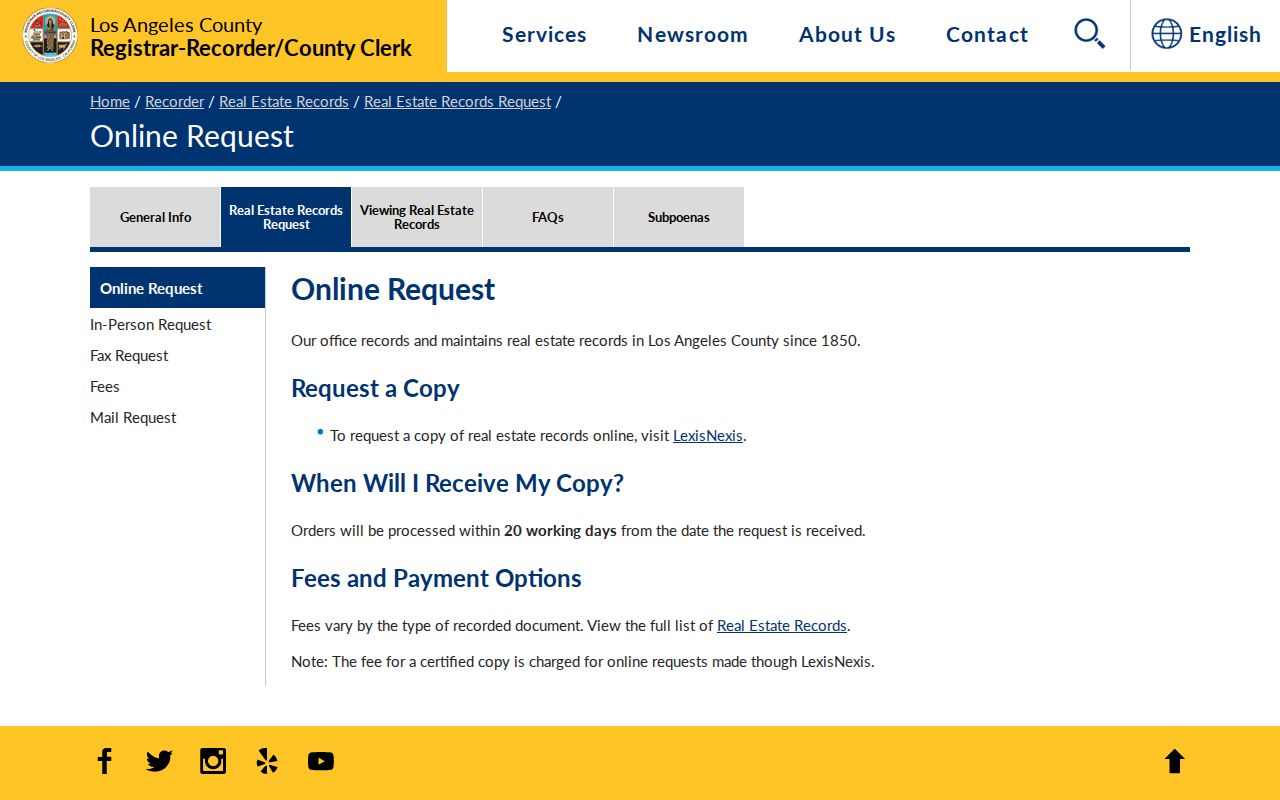
Use the request path when Norwalk is not practical. Name the parties, document type, exact year or years, and recording detail.
Viewing is at 12400 Imperial Highway, Norwalk, California 90650, Room 2207, Monday through Friday, 8:00 a.m. to 5:00 p.m. Telephone: 800-201-8999; email is recorder@rrcc.lacounty.gov. Copies are ordered online, by mail, fax, or in person. Online orders may take up to 20 working days.
Charges are $5 for the first plain-copy page, $3 per added page, $6 for the first certified page, and $3 per added certified page. Mailed index research is $0.50 per name per year, $1 minimum. Card handling is $1.75; expedited UPS is $18.50 where available.
The RR/CC recorder FAQ confirms that the whole document must be purchased, not selected pages. The index supplies parties, year, date, document number, and book-and-page placement; the document adds title, legal description, execution details, and transfer-tax or exemption language.
Mail requests to Real Estate Records, P.O. Box 1130, Norwalk, CA 90651-1130. State the title, indexed names, and exact years. A broad hunt starts with the AIN and Assessor-supplied owner.
Los Angeles Previous Residents and Occupancy
Ownership is only one layer of the Los Angeles previous residents trail. Assessor parcel detail shows situs, AIN, legal description, improvements, values, and year-built fields, but not owner name or mailing address online. Tax data from an AIN do not establish occupancy. Census QuickFacts reports 36.0% owner occupancy in Los Angeles for 2020-2024, so a title holder is not a proxy for every household member.
Helpful distinction. Assessor values and situs data are public online, but owner and mailing details are not. A missing owner name is an access limit, not proof that a parcel has no owner.
For household evidence, use Los Angeles directories, LAPL's 1900-1968 voter-registration collection, and census schedules through 1950. One source may list one adult, another a larger household, while a deed names an entity. Preserve each record's role.
Reverse Directories for Los Angeles Addresses
Los Angeles reverse directories turn the search around. Instead of looking up a surname to find an address, start with a street and number to see the listed resident or business. The LAPL History and Genealogy guide covers city directories in paper and film for 1873-1942, while Tessa's digitized selection spans 1875-1987. Later runs include street and reverse approaches. The Tessa City and Street Directories collection supports keyword search, page images, and browsing by title and publication date.
Search tip. ResCarta address searches may need a literal h for householder or r for resides, plus period abbreviations and scanned-text (OCR) variants such as “Ave 64” and “Avenue Sixty-Four.”
Reverse runs are strongest in 1906, 1927, and 1956-1987, but entries can be omitted, misread, or tied to a business address. Check the volume's front matter, publisher, geographic statement, and abbreviation key. Full shelf history belongs with the Los Angeles city directories; the address trail uses only entries needed to place past residents at one parcel.
Los Angeles Past Households
Pairing sources makes an address hit a household timeline. Copy the name, address, occupation mark, spouse mark, and nearby entries from a directory, then test the address against census years and voter registrations. LAPL's Ancestry Library Edition covers 1900-1968; its census holdings are complete for 1790-1900 and 1920, partial for 1910 and 1930. Public census access reaches 1950 under the 72-year rule.
- Copy the full entry and page or image reference.
- Compare nearby volumes for arrival, move, spelling change, or disappearance.
- Use the street section to test co-addressed listings and block order.
- Bridge the dated address to voter registrations and census schedules.
- Use deeds for ownership, newspapers for moves, and probate or death records when the trail ends.
Los Angeles newspapers add obituaries, notices, transfers, and address events. LAPL's Los Angeles Times run covers 1881-1990; its guide lists the Los Angeles Sentinel for 1934-2004. A missing listing proves nothing. OCR, initials, married names, boundaries, and publication choices break sequences.
Los Angeles Sanborn Maps
Sanborn maps place a building in its physical setting, not in a resident roll. LAPL's original downtown atlas dates to 1888 and expanded in 1894. Original volumes cover 1906-1930, a corrected 1950 set follows, and later Los Angeles-only updates extend through 1970. The map desk holds a Master Address Index, 72 microfilm reels, and about 60 hard-copy mid-century volumes. The documented call numbers are NR 912.794 S198 for 1888-1950 and NR 912.794 S198-1 for the 1950s through 1970; the map librarian's phone is 213-228-7414.
The Library of Congress Sanborn collection supplies selected digital scans, while the richer local set remains a LAPL research route. Use the Master Address Index to test an old number, then compare the footprint, building use, and street name with a directory entry. A map can explain why an address search fails after a renumbering, but it names no household and cannot replace a deed or directory.
McCadden and Former Los Angeles Towns
Address history in Los Angeles can fail when a street name or number changes. One official cultural-heritage report documents a 1912 change involving 1542 McCadden Place during wholesale street-name matching and renumbering. Test an old address against directory street sections, Sanborn map indexes, the parcel's legal description, and the AIN instead of assuming that a modern search failure means no earlier household existed.
Former municipalities add another layer. Hollywood consolidated in 1910, Sawtelle in 1918, Eagle Rock and Hyde Park in 1923, Venice in 1925, Watts in 1926, and Tujunga in 1932. Los Angeles County was one of California's original 27 counties in 1850, so obsolete court names matter before 1880. The City Archives began formally in 1980, preserves records to 1827, and holds pre-annexation material for Eagle Rock, Hollywood, San Pedro, Tujunga, Venice, Watts, and Wilmington. Cite the full title, publisher, year, page, or image.
Los Angeles Probate and Obituary Trails
When a directory listing disappears, an obituary, cemetery index, probate file, or newspaper notice may explain it. LAPL maintains about 200 printed vital indexes and cemetery books, plus its California Index of citations to Southern California people, places, and events. Staff do not promise obituary searches, but the genealogy department keeps a paid-researcher directory. Search name, address, spouse, and dates, then check the original source.
Probate files and wills belong to Los Angeles Superior Court, not the recorder. The Superior Court case-access route can lead to a case number or division search. Its Archives & Records Center, 222 N. Hill Street, Room 212, holds mainly 1910-2004 civil, family, felony, probate, and juvenile material. Terminals are free; copies cost $0.50 per page and certification $40. Mail work may take 8-10 weeks and needs the case or name, year, document, certification choice, envelope, and not-to-exceed check.
Note: A missing obituary or directory entry narrows a search but cannot prove that a person died, moved, or was never present.
Lawful Los Angeles House History
A careful Los Angeles house history uses the LAPL house-history guide as a source map: deeds, Assessor records, permits, directories, maps, newspapers, REDI, and LUPAMS answer different questions. Verify a striking claim with the office or collection holding the underlying record.
Lawful house history. Previous-resident research in Los Angeles is appropriate for genealogy, family history, preservation, and personal curiosity. Do not use records to stalk, harass, threaten, or track a living person. Keep privacy-protected addresses and nonpublic household data private.
Previous residents are dated evidence, not a roster. Preserve source, role, address form, and date. At an old municipality, missing scan, or protected record, stop at the boundary and use the custodian.