
How to Find Residents in Los Angeles
No single resident roll covers Los Angeles. Each question starts somewhere different. It might be a name, a street, a past household, a court party, or a vital event. Each one leads to a different custodian. The Assessor works from an address or an AIN. It returns parcel facts rather than a public owner-name directory. Voter verification stays a self-check. The Recorder's deed index is searched at Norwalk. Superior Court and library sources supply case trails and older names.
Match the source to the question first. Then pull a second record before treating two entries as one person. A parcel can explain ownership, yet not everyone at an address. A residents directory can show a listed household, but an omission never proves absence.
- Start with what you have. Use the Los Angeles Assessor for an address or AIN; use a dated name for person research.
- Check the matching roll. Los Angeles voter verification is personal; court and vital tools answer other questions.
- Confirm property. Take the AIN or legal description to the Los Angeles Recorder's Norwalk name-and-year index.
- Add time. Use Los Angeles directories, census, newspapers, voter registrations, probate, or an obituary.
- Request missing records. Route a Los Angeles City request to its department, or ask the county or state custodian.
Where Los Angeles Keeps Resident Rolls
Resident records in Los Angeles County sit under one umbrella but open through different doors. The county combines recorder, county-clerk, and registrar-of-voters work under RR/CC. Access rules differ by record type. The Assessor runs a free parcel search yet keeps owner information off the public website. Elections offers self-verification plus controlled file orders. Superior Court adds its own name, case-number, terminal, and archive routes. Those serve a resident lookup with a legal angle.
Los Angeles County RR/CC Recorder
12400 Imperial Highway
Norwalk, CA 90650
800-201-8999
Los Angeles County Assessor
Countywide parcel service
Owner data at offices or through Property Data Sales
helpdesk@assessor.lacounty.gov
Public Basic, Legal, and Map Search
Los Angeles County Elections
12400 Imperial Highway
Norwalk, CA 90650
800-815-2666
Voter status and file-order channels
Los Angeles Superior Court
County trial-court records
Name, defendant, case-number, and image routes
Archives and courthouse terminals
Different fees and limits by service
Los Angeles City records stay separate from the county's. City Hall, the City Records Center and Archives, City Planning, and LADBS hold municipal files, permits, planning cases, and department contacts. The Los Angeles street address directory is the better place to follow a parcel one address at a time, while the home route only sets the custody map.
Los Angeles Assessor AIN Search
Start with the Los Angeles County Assessor Portal for any current parcel. The search is built around addresses. That is its whole design. There is no owner-name lookup. A Los Angeles street directory style search by resident name will not work here. Try the street address first. If a corner lot or multi-unit building confuses the search, switch to the map view and pick the parcel visually. Save the AIN once you have it. That number unlocks the rest of the Los Angeles records trail.
The portal returns a solid stack of parcel facts. You can see the situs address, parcel type, assessed values, improvements, year built, legal description, status, and roll-detail references. Owner name and mailing address stay offline. For those, visit a Los Angeles Assessor office or go through Property Data Sales. The library's house-history guidance offers an email route for AIN help. The Assessor Portal displays the address and AIN search surface that anchors Los Angeles parcel research.
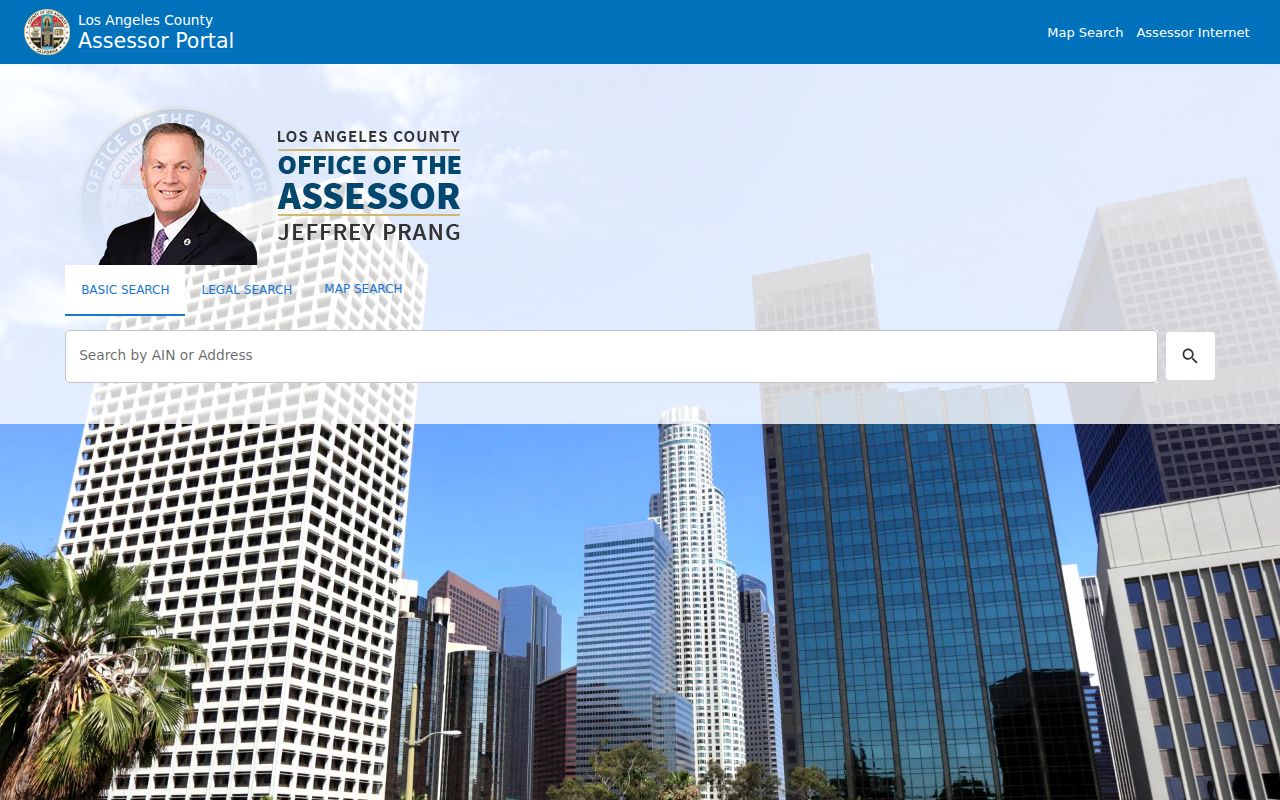
The parcel screen anchors deeper work, but it is not a household list. It identifies the legal land unit and leaves ownership and occupancy to other records in the Los Angeles residents directory toolkit.
| Search field or mode | Type | Required | What it does |
|---|---|---|---|
| Search by AIN or Address | Autocomplete text | Yes | Accepts a ten-digit AIN such as 5190-018-032 or a street address. |
| Basic Search | Tab or button | Not stated | Opens the address and AIN parcel path. |
| Legal Search | Tab or button | Not stated | Uses tract, block, lot, or legal-description clues. |
| Map Search | Map link | Not stated | Lets a researcher pan, zoom, and select a visible parcel. |
Los Angeles Deeds at Norwalk
Los Angeles County recorded real-estate records reach back to 1851. Yet the Recorder posts no public Internet index or document images. Recorded documents may hold protected home addresses of officials. The county cannot separate those from a full web index. A deed stays public, but the search starts at the counter or through a specific copy request.
At Norwalk, an appointment opens alphabetical grantor and grantee indexes by name and recording year. Material from 1851-1957 sits downstairs; 1958-present is upstairs. The office will not search by telephone. A known document can be ordered online, by mail, fax, or in person. A mailed request names the party and years.
Plain copies cost $5 for the first page and $3 for each additional page. Certified copies add a $6 first-page charge. Mailed index research runs $0.50 per name per year with a $1 minimum. Online orders may take up to 20 working days. The full document must be purchased. The county's recorded-document request route supplies the requirements.
Current Los Angeles Resident Directory Sources
Current Los Angeles records look like a residents directory only when their limits sit beside them. The Assessor describes a parcel. The voter form checks one person's own status. A deed names parties to an instrument. The Los Angeles City directory lists public officials and departments. Permit and planning files add dated applicants or representatives. No single source proves who lives in every unit, so a thorough resident lookup always stitches several together.
| Source | What it can show | Custodian | Access |
|---|---|---|---|
| Assessor parcel roll | AIN, situs, legal description, values, improvements, and year built | County Assessor | Free web search; owner channel offline |
| Voter self-verification | One registrant's status and address-field match | County Registrar of Voters | Free form with four required fields |
| Recorded deed index | Grantor, grantee, title type, and recording reference | County RR/CC | Norwalk index or known-copy order |
| City Directory | Elected officials, departments, phones, emails, and official accounts | City of Los Angeles | Free online public-service directory |
| Permit and planning files | Applicants, contractors, cases, inspections, and project dates | LADBS and City Planning | Online where posted; request missing scans |
The City of Los Angeles directory names people in public roles. It does not cover private residents, so treat it as one thread of a Los Angeles residents directory search rather than the whole cloth.
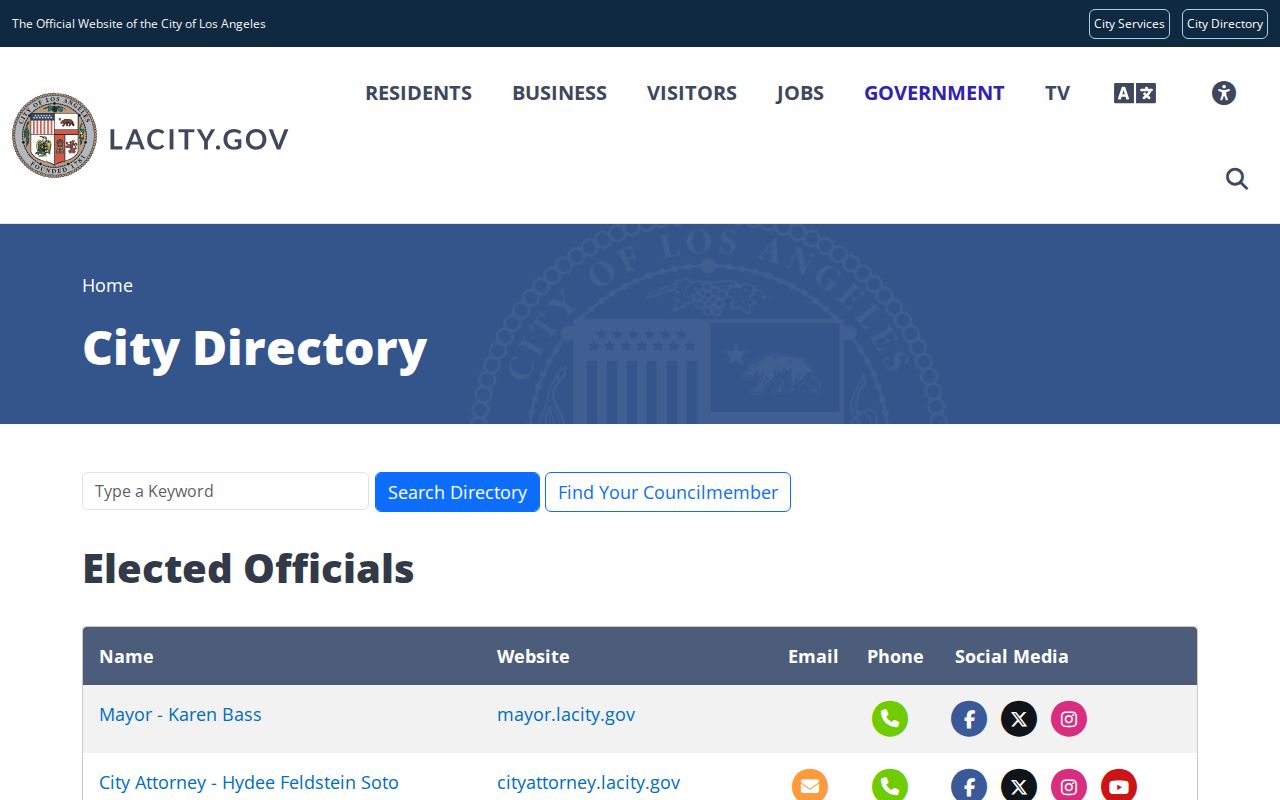
Treat any current residents directory row as a lead, not a verdict. Before you lean on it for family, neighborhood, or civic work, confirm the date, the role, the address type, and which records office holds the original entry.
Los Angeles Voter Check Is Personal
The Los Angeles County voter form exists for a person to verify their own registration. It is not a public street browse. It cannot reveal a list of registered people at an address. The form asks for four matching pieces: last name, full birthdate, residence house number, and five-digit ZIP Code. Assistance waits at 800-815-2666, option 2.
- Last Name: alphabetic text, required.
- Birthdate: date in month/day/year form, required.
- House Number: residence number only, required.
- Zip Code: five digits, required.
Full voter files sit behind Elections Code sections 2188 and 2194. Political, election, scholarly, journalistic, and governmental purposes can qualify. Commercial use is barred. The county order channel requires a written request plus a permissible-use certification. Fees are fixed by file type: $146 for countywide data, $54 for a precinct, district, or city file, and $39 for each additional file. Requests go by mail or in person. Send them to Election Information, second floor room 2013, 12400 Imperial Highway, Norwalk.
The county voter information request route describes the controlled files and how to order them. Outside those channels, confidentiality applies. A voter's home street address, phone, email, precinct, prior registration, identification numbers, and signature stay confidential. Historical questions follow a different path. LAPL's licensed California Voter Registrations collection covers 1900-1968.
Los Angeles Court Case Search
Searching court cases in Los Angeles starts with a party name or a case number. A name search is a paid index. It bills $4.75 whether it matches anyone or not. The case-number summary works better once a number is in hand. Name coverage stretches across unlimited civil, family law, and probate files from 1983. It also covers limited civil from 1991 and small claims from 1992. A single result can list the party, the role, the case type, and the filing date. It can also show the courthouse, the case number, and how many images sit in the file. Criminal defendant lookups run through a separate service. The Los Angeles Superior Court case-access source page is where that trail begins.

Treat any case image here as a signpost rather than the official file. Guest name searches carry the same fee regardless of results. A case-number summary is the smarter follow-up when the number is known. Bought images stay viewable for 30 days. Courthouse terminals open electronic public files for free.
- Placement: case number, courthouse, date, type, and status.
- Identity: caption, names, roles, and public counsel.
- Activity: actions, hearings, dispositions, and judgments when public.
- Documents: eligible images may be purchased.
- Limits: sealed, juvenile, adoption, protected family, and other confidential material stays out.
Older case paper lives at the Superior Court Archives and Records Center, 222 N. Hill St., Room 212. The collection holds mostly 1910 through 2004 material. Terminals there are free, copies run $0.50 per page, and certification costs $40. Mail requests can take 8-10 weeks. Include the case number or name, the year, the document, and whether certification is wanted.
Los Angeles Vital Copy Rules
Vital records in California hinge on the copy type and the requester's relationship. There is no one simple age rule. Los Angeles County RR/CC is the local route for county births, deaths, and public marriages. County Public Health covers current and recent birth and death events. The statewide alternative is the California Department of Public Health. It takes mailed applications and separates informational copies from authorized ones. The California vital-records source lays out that state route. Keep these distinctions close by during any Los Angeles residents directory search.
- Birth: the state 2026 fee is $31; county holdings start in 1866 and a county copy is $34. Authorized copies require an eligible relationship or legal basis and a notarized statement under Health and Safety Code sections 103525-103526.
- Death: state and county routes offer informational or authorized copies; the 2026 state fee is $26.
- Public marriage: identify both parties, date, and county; the 2026 state fee is $19.
- Confidential marriage: the County Clerk holds it; Family Code section 509 limits access to the parties or a court-authorized person.
- Divorce: CDPH can issue a certificate for specified years, but Superior Court holds the decree and file.
Los Angeles County serves walk-in customers by appointment only. Photo ID is required at the counter. Mail and online ordering stay open as alternatives. VitalChek adds handling fees, and orders generally finish processing within 20 business days. CDPH applications go the paper route: a signed form plus a check or money order. Adoption files, original birth records, confidential medical details, and confidential marriages all stay restricted. They sit outside the standard residents directory flow.
Los Angeles City Records by Department
Los Angeles keeps each municipal record with the department that created it. The City public-records request portal is the single entry point. It asks for the department, a description, dates, address, AIN, and case number. You also give contact details and an electronic format. Remember that requests themselves are public. Search existing requests first. Then send the question straight to the custodian. Do not ask an office to build a list it never kept.
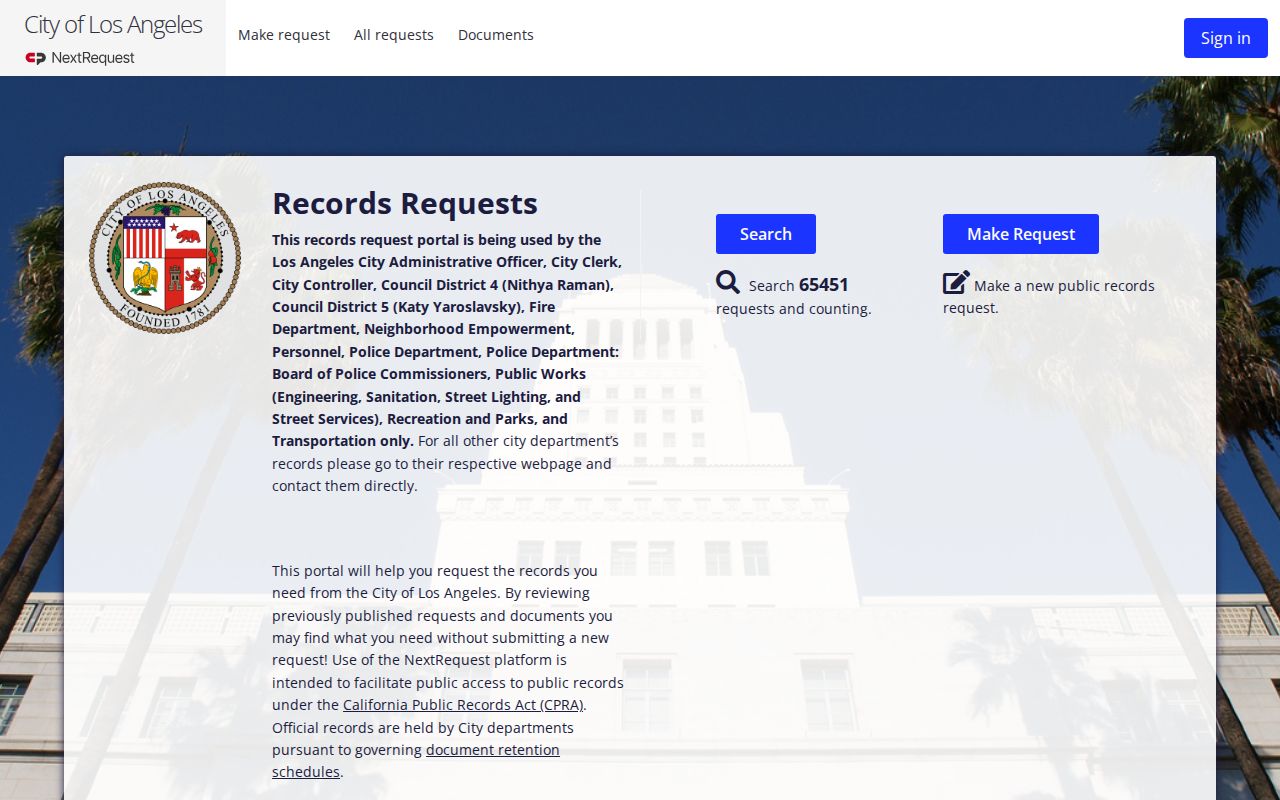
The portal image shows the City route for department records only. County deeds, voter files, vital certificates, and Superior Court files do not run through it. City Hall sits at 200 N. Spring Street. Dial 311 inside the city, or 213-473-3231, for general routing. City Clerk work happens at City Hall. Records Management and City Archives occupy the C. Erwin Piper Technical Center at 555 Ramirez Street, third floor, Space 320.
City Archives holdings reach back to 1827. The collection spans council files, petitions, maps, photographs, ledgers, precinct maps, and pre-annexation material. RR/CC runs its own CPRA route. Its determination window is ten days. That window can stretch up to 14 more days for unusual circumstances. When in doubt, send a targeted request. Address it to whichever office made the record in the first place.
Los Angeles Resident Directories from Earlier Years
Historical Los Angeles resident directories supply the time layer that current parcel and voter tools lack. LAPL Central Library's History and Genealogy Department holds roughly 52,000 genealogy titles, census microfilm, newspapers, California Index citations, maps, and Los Angeles city directories in paper and film covering 1873-1942. Its digitized city and street directory selection reaches 1875-1987. A single volume can tie a name to an address, occupation, spouse notation, or business. An omission, though, proves nothing. The LAPL genealogy source page lays out the library collection behind this historical residents directory work.
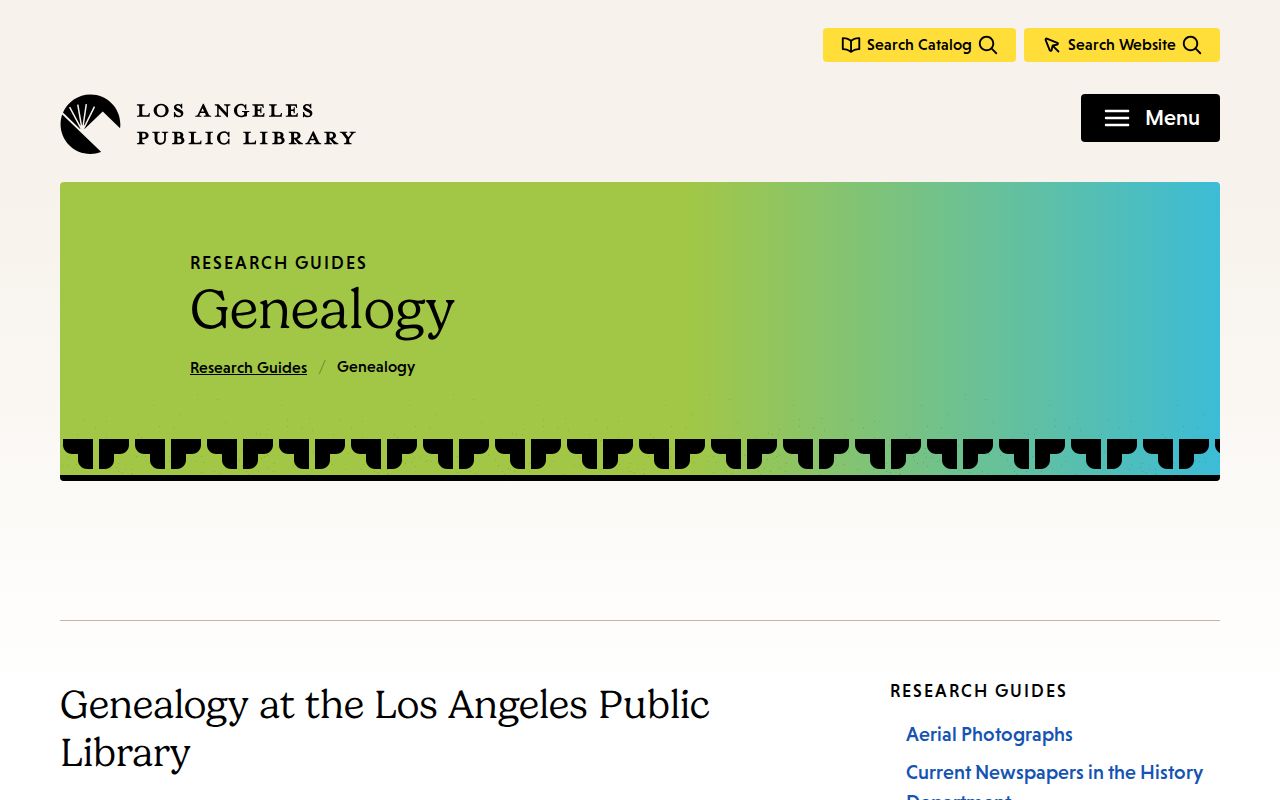
Reverse sections flip the search. Street, number, then the listed household or business: that is the order of a reverse street directory. Try initials and OCR variants. Try `h` for householder and `r` for resides, and learn the street abbreviations of the period. Pair each directory year with census, voter, newspaper, probate, or deed evidence. The full shelf and publisher chronology sit on the Los Angeles city directory collections page. Its reading method is there too.
Match a Los Angeles Name to Records
One matched name is a lead. It is never proof. In a Los Angeles residents directory search, tie an identity down with two independent links: a middle initial paired with a birth date, the same AIN paired with a legal description, or a dated business filing matched to a court chronology. Each source names a role, and the role matters. A permit applicant, a property owner, an agent for service, a license mailing address, or a deed party may connect to the resident without being that resident. Write down the role the record actually shows.
Scale is why this discipline counts in Los Angeles. The 2020 census counted 3,898,747 residents spread across 469.49 square miles, and QuickFacts puts owner occupancy at 36.0% for 2020-24. An owner record therefore tells you little about everyone else at an address. Run surname searches in compound, spaced, hyphenated, initialed, and OCR-mangled forms. Never assume a shared surname means a family relationship. A broad commercial result can open a trail, but the custodian's record closes it.
| Official record trail | Commercial compilation category |
|---|---|
| Named custodian, date, role, and access rule | Mixed public, marketing, and user-supplied data |
| Counter, mail, portal, or certified-copy path | Bundled search interface with unclear timing |
| Best for confirming a parcel, case, event, or historical entry | Lead only; entries can be stale, merged, or wrong |
- Roll
- An organized assessment or tax record for parcels and values. It is not a household list.
- Index
- A finding aid, such as a party and year entry or a case result. The full document may require another request.
- Criss-cross directory
- A reverse directory arranged by street address, often with householder or residence marks. Coverage is periodic and incomplete.
- Parcel
- A legal land unit identified by an AIN and description. One parcel can contain more than one unit or household.
Los Angeles Addresses Cross Jurisdictions
A Los Angeles mailing address proves nothing about jurisdiction. The name can sit on a parcel outside the City of Los Angeles entirely. Countywide Assessor data, city ZIMAS layers, ZIP code directory boundaries, incorporated-city limits, and unincorporated territory each answer a different geographic question. So pick the layer that fits the question. Inside the city, ZIMAS returns address, intersection, APN, and legal description. It also shows cases, planning layers, council district, and Neighborhood Council geography. For unincorporated territory, GIS-NET Public adds county parcel tools, layer control, identify, and buffer functions. Measure, report, and export functions come with it too.
Time breaks the trail too. Hollywood consolidated in 1910. Sawtelle followed in 1918. Eagle Rock and Hyde Park joined in 1923, Venice in 1925, Watts in 1926, and Tujunga in 1932. An old street directory or deed may use a vanished jurisdiction and older street vocabulary. Keep the period name, the legal description, and the current parcel clue side by side. Otherwise two address trails that are really one will look like different places.
What Los Angeles Public Records Leave Out
Some gaps are protections, not dead ends. A missing result in a Los Angeles resident lookup can mean the record is confidential by law. Voter address, phone, email, precinct, prior registration, identifiers, and signature stay sealed. They remain sealed outside controlled Elections Code channels. DMV residence data are restricted the same way. Safe at Home gives eligible participants a substitute address. Government Code section 6208.1 limits public display after a qualifying demand. Adoption files and original birth records also stay closed without statutory or court process.
Court material follows its own rules. Sealed, juvenile, protected family, and other restricted case files never open up. They stay closed even when a related deed or city directory entry exists. Privacy deletion rights, by contrast, apply to private data brokers. Official records stay with their custodians.
California's DROP platform is the state's answer to broker data. A resident sends one encrypted deletion request to every registered broker. It does not erase official records. Save the confirmation numbers and check spelling variants. Correct any errors with the source agency itself.
Los Angeles Homeowner Alert Watches AIN Events
Los Angeles Homeowner Alert watches AIN events for a current owner of record. When the Recorder completes a document, the service can push the AIN, document type, recording date, and document number by email or text. It detects events. It does not reverse them. Compare any notice against Assessor and RR/CC channels, then report a concern promptly.
The current enrollment route runs through the County's Homeowner Alert service. Keep it beside your Los Angeles residents directory workflow rather than inside it. The notice flags a document event. Directories, court files, voter rules, and historical sources answer separate identity questions. Date every result. Verify it with the custodian.