
Los Angeles City Directory Holdings
Los Angeles uses overlapping directory runs, not one unbroken series. LAPL's paper and film core covers 1873-1942; Tessa's selected digital run reaches 1875-1987. City and business volumes end in 1970, while reverse volumes continue to 1987. Cite title, publisher, year, page, and image reference so those endpoints are not mistaken for one final date.
| Collection | Years | Where Held | Access |
|---|---|---|---|
| Los Angeles city directories, paper and film | 1873-1942 | LAPL Central History & Genealogy | Reference room and microfilm readers |
| Tessa City and Street Directories | 1875-1987 selection | LAPL Tessa digital collections | Online search by name, address, or business |
| Los Angeles Street-Reverse Directories | 1906, 1927, 1956-1987 | Tessa and LAPL reference holdings | Address-first pages; verify geographic scope |
| California voter registrations | 1900-1968 | LAPL and Ancestry Library Edition | In-library access; compare the street address |
| Sanborn fire-insurance maps | 1888-1970 | LAPL map collection and LOC scans | Map desk, microfilm, hard copy, or online |
| Newspapers and California Index | 1881-forward for major Times holdings | LAPL microfilm, databases, and Tessa | Library access and citation follow-up |
Year gaps may reflect a digital selection, a missing shelf year, or a nearby title. Early books sometimes covered county territory or business districts outside today's city. Read the title page and geographic statement before treating an entry as a Los Angeles city record.
The Tessa city and street directory collection shows the digital shelf for Los Angeles directory research.
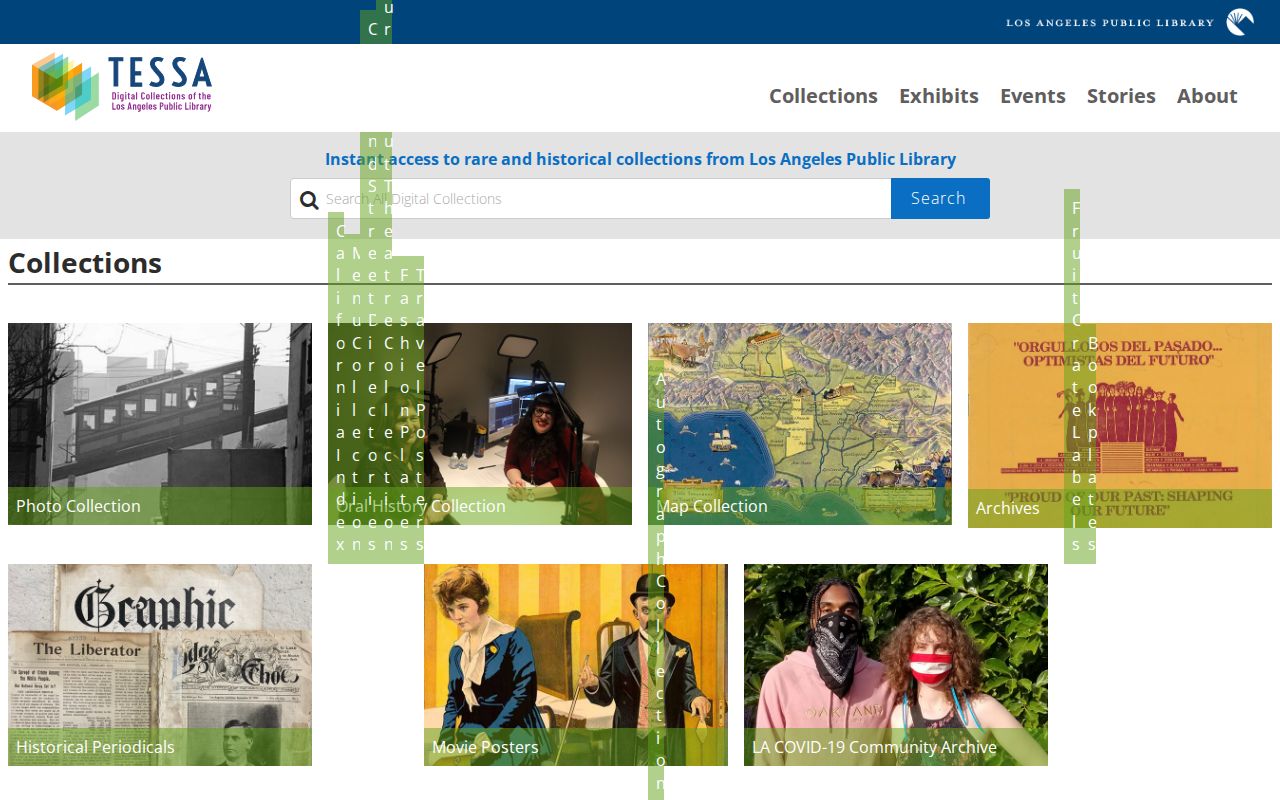
Page images and reference links are useful, but the volume's own scope controls how a name or address should be read.
Publishers That Shaped Los Angeles City Directories
The first Los Angeles directory appeared in 1872 and is extremely rare. The accessible sequence begins with the 1873 Los Angeles City Directory, followed by 1875, 1878, 1879-80, and 1881-82 volumes. Atwood produced 1883-84; Maxwell's and Smith & McPhee appear in 1887-88; the Los Angeles Business Directory and Mercantile Guide follow in 1890-91 and 1892-93. Publisher names matter because format, abbreviations, coverage, and street-page order changed.
Specialty volumes include the 1899 Catholic directory, census, and diocesan gazetteer; San Pedro and Terminal Island in 1902; the county telephone directory in 1904; Hollywood/Baumgardt in 1905-06; the 1906 Los Angeles Street and Avenue Guide; and the 1930-31 Los Angeles Negro City Directory. Cite the last title in its historical context rather than treating it as a generic name list.
Telephone books are separate. LAPL catalogs an 1882 volume with 90 resident and business numbers, including Southern Pacific as number 1. A listing is a dated clue, not proof of a later address.
Search Los Angeles City Directories in ResCarta
Tessa's ResCarta interface offers Browse Collections, Browse Titles, Simple Search, and Help. Select a collection or subcollection, enter a keyword, sort by publication date, and open the page-image viewer. The named subcollections include Historic City and Business & Phone Directories and Los Angeles Street-Reverse Directories. Save the viewer's reference URL with the volume and page.
ResCarta searches names, addresses, and businesses, but OCR is not the page itself. Browse adjacent pages and inspect the front matter for the abbreviation key. Early books can include county residents or San Francisco businesses, while reverse books can cover communities now inside Los Angeles or other county cities. The volume's geographic statement outranks a modern boundary assumption.
Read a Los Angeles City Directory Entry
An entry is a compact clue set. The alphabetical section starts with a surname and given name or initial. A spouse may appear in parentheses, followed by an occupation code and residence address. Widow or widower notation may identify a deceased spouse. Business listings use a different logic.
| Name | Surname, given name, initial, and sometimes a spouse in parentheses. |
|---|---|
| Spouse or family clue | Parenthetical spouse, widow or widower notation, or repeated names. |
| Occupation | Work description or a code explained by the volume key. |
| Address | House number and street, with variable suffixes or compass terms. |
| Owner or renter mark | Copy any occupancy mark. Common clues are h for householder or home and r for resides or rooms. |
A reverse or criss-cross section changes the order from person-first to street-first. A householder index centers the main resident entry, while an abbreviation key explains short codes for occupations, residences, streets, or rooms. Transcribe that key before expanding a mark.
- Criss-cross directory
- A reverse section arranged by street and number so an address leads to a listed name or business.
- Householder index
- An index centered on the main household entry, not a complete list of everyone present.
- Abbreviation key
- The volume's guide to short forms, usually in the front matter.
Absence is not proof. A household could decline a listing, appear under one adult, move before publication, use a business address, or be lost to OCR. Pair the exact line with another record from the same period.
Reverse Volumes Put Streets First
Los Angeles reverse runs are identified for 1906, 1927, and 1956-1987. Turn to the street and number to read nearby listings and spot changed names or numbers. It remains a publication snapshot, not a complete list of people who used a building.
Use the printed spelling exactly. “Ave 64” may not match “Avenue Sixty-Four,” and “Bway” may stand for Broadway. For current address records, the Los Angeles by-street directory handles assessor, parcel, and deed sources separately.
Central Library's Los Angeles Directory Shelf
LAPL History & Genealogy at Central Library, 630 W. Fifth St., is the main in-person route. It reports about 52,000 genealogy titles, more than 5,000 rolls of U.S. city-directory microfilm, earlier microfiche, and about 1,000 hard-copy U.S. directories. Los Angeles paper and film cover 1873-1942. Quick reference is 213-228-7400; group tours use 213-228-7413. Reference items ordinarily remain in the library, and Ancestry Library Edition is used on site.
The LAPL genealogy guide and house-history guide point to census film, California Index citations, newspapers, maps, directories, and cemetery books. Staff do not promise full genealogy or obituary searches, but maintain a paid-researcher list.
The California State Library genealogy collection adds catalogs, California-history material, manuscripts, and research-room resources. It is not a universal current-resident index, so confirm the relevant catalog or record group first.
The California State Library's genealogy and California-history resources offer a second view of the broader shelf used by Los Angeles researchers.
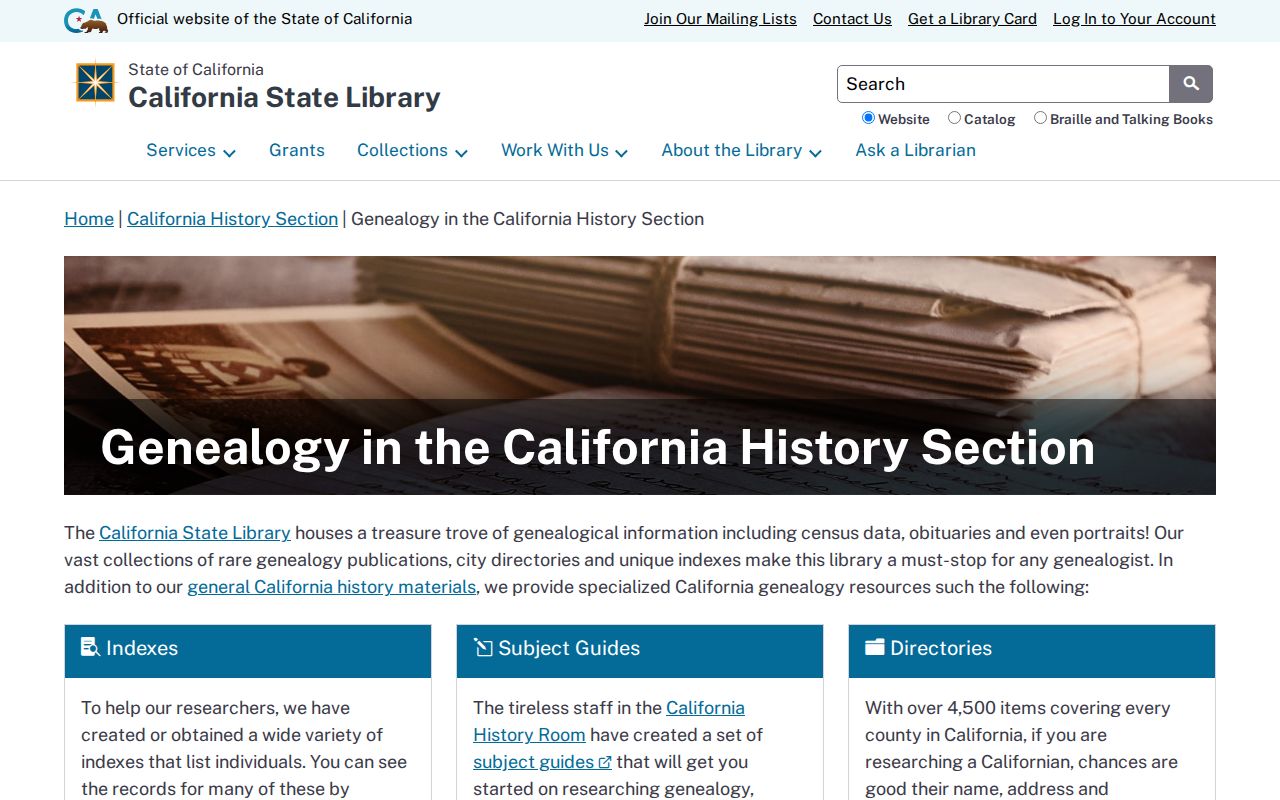
The image leads to the State Library entry point; LAPL remains the local stop for Los Angeles paper, film, and reference help.
Trace a Los Angeles Directory Household
A directory trace works best as dated comparisons. Start with one known name, address, or family connection, then test it against records created for a different purpose. Deeds show ownership; directories, census pages, and voter registrations describe other kinds of presence.
- Choose a year and transcribe the entry, including initials, spouse notation, occupation code, address, publisher, and page.
- Check nearby annual or biennial volumes for first appearance, moves, altered street spelling, and last appearance.
- Pair dates with federal census years through 1950. LAPL has extensive film, complete for 1790-1900 and 1920, and partial for 1910 and 1930.
- Use California voter registrations from 1900-1968 through Ancestry Library Edition at LAPL. Compare the quoted street address.
- Close gaps with newspapers, California Index citations, cemetery books, or an obituary lead. Use deeds only for ownership.
Test initials, married or widowed names, diacritics, street suffixes, and OCR errors. A same-name match should align on address, spouse, occupation, age, or another period detail. For a present-day identity check, use the official routes in the Los Angeles resident lookup.
Los Angeles Newspapers Test Missing Directory Entries
A missing entry is not proof of absence. Newspapers can explain a disappearance. LAPL holds the Los Angeles Times from 1881 forward on microfilm, with a guide for 1881-1990. Other runs include the California Eagle 1914-1964, Daily News 1923-1954, Evening Post-Record 1896-1936, and Evening/Hollywood Citizen News 1907-1970. Obituaries, notices, transfers, and address events can bridge entries.
The California Index cites Southern California people, places, and events in newspapers, periodicals, and books. Foreign-language papers are in International Languages holdings. An obituary search is not guaranteed, and absence of a notice proves little. Record title, date, page, and film or archive reference.
Sanborn Maps Explain an Address Shift
LAPL's Sanborn story helps when an old address will not match. The downtown atlas began in 1888 and expanded in 1894; local sets cover 1906-1930, a corrected 1950 set, and Los Angeles-only updates through 1970. The map desk holds a Master Address Index, 72 microfilm reels, and about 60 hard-copy volumes. Call numbers are NR 912.794 S198 for 1888-1950 and NR 912.794 S198-1 for the 1950s-1970; the map librarian is 213-228-7414.
Use the Library of Congress Sanborn map collection for selected scans, then ask LAPL about local film or hard copy. A map can bridge a changed address or show a site's use, but it cannot replace a name entry or county deed.
Los Angeles Directory Archives
Los Angeles municipal archives add context around a directory entry. Clerk records reach the 1830s, formal archives began in 1980, and holdings reach 1827. The C. Erwin Piper Technical Center, 555 Ramirez St., third floor, Space 320, lists 213-473-8440 and Clerk.RMD@lacity.org; appointments run Monday through Thursday, 8:00 a.m. to 4:00 p.m. Pre-annexation Eagle Rock, Hollywood, San Pedro, Tujunga, Venice, Watts, and Wilmington records preserve older geography.
Council files have indexes for 1940-1979 and 1980-forward. For unposted municipal records, use the City of Los Angeles public-records portal and name the department, dates, address, or series. It does not hold county deeds or Superior Court files.
The National Archives at Riverside is the Southern California federal repository. Its catalog and research room cover record-group-specific federal court, immigration, census, and agency material, not a general current-resident index.
National Archives at Riverside is the federal access point for record groups outside the local shelf.
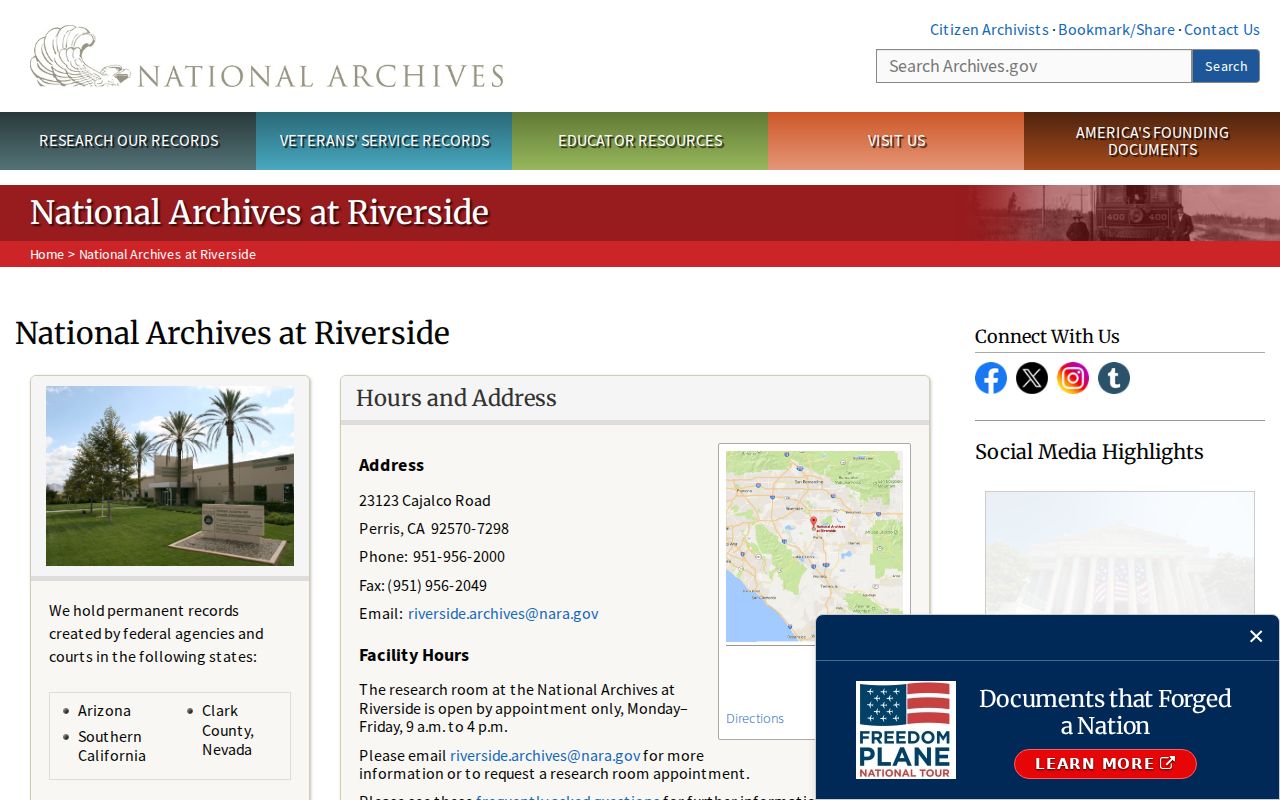
Identify a record group before expecting a catalog result or reproduction route.
| Year or period | Recordkeeping milestone |
|---|---|
| 1827 | Earliest municipal material preserved in the City Archives. |
| 1872-1873 | The first directory is rare; the accessible sequence begins in 1873. |
| 1883-1893 | Atwood, Maxwell's, Smith & McPhee, and Mercantile Guide titles mark publisher changes. |
| 1906-1970 | Reverse runs begin; city and business volumes reach 1970. |
| 1980 | Formal City Archives begins while older Clerk and pre-annexation material remains. |
| 1987 | Tessa's selected reverse run reaches 1987. |
“Last city directory” is too simple. Printed, telephone, specialty, reverse, map, newspaper, and municipal series answer different questions. Cite the exact series and access point.